Introduction of 212 IPC
IPC Section 212 punishes anyone who deliberately helps a criminal avoid arrest or punishment. This can be done by hiding them, giving them shelter, money, or misleading the police. However, close family members have some protection under this law. The severity of the punishment depends on the seriousness of the main crime.
- Introduction of 212 IPC
- What is IPC Section 212 ?
- IPC 212 in Simple Points
- Section 212 IPC Overview
- Detailed Explanation of 10 Key Points
- 1. Harbouring an Offender – What it Means
- 2. Knowledge of the Crime – Important Factor
- 3. Protection for Family Members
- 4. Difference Between Serious and Minor Offenses
- 5. Punishment for Harbouring an Offender
- 6. Intent Matters – Must Be Deliberate Help
- 7. Applies to Various Crimes – Not Limited to a Specific Offense
- 8. Different Forms of Help Count as Harbouring
- 9. Arrest and Legal Procedure
- 10. Legal Defenses – Who Can Escape Punishment?
- Section 212 IPC case laws
- 212 IPC Punishment
- 212 IPC Bailable or non bailable
- Section 212 IPC in short information
- IPC Section 212 FAQs
- If you need support with court proceedings or any other legal matters, don’t hesitate to reach out for assistance.
What is IPC Section 212 ?
IPC Section 212 punishes a person who knowingly shelters or assists an offender who has committed a crime. This applies when the person providing shelter knows that the offender is trying to escape punishment. However, close family members of the offender are given some protection under this law.
IPC 212 in Simple Points
1. Meaning of Harbouring an Offender
- Harbouring means helping a criminal escape by providing shelter, food, money, or any other support.
- If a person intentionally helps a criminal, they can be punished under IPC 212.
👉 Example: If someone hides a murderer in their house to prevent arrest, they are guilty under IPC 212.
2. Knowledge of Crime is Necessary
- The person must know that they are helping a criminal.
- If they help without knowing, they are not guilty.
- Intent is important – If help is given unknowingly, IPC 212 does not apply.
👉 Example: If a shopkeeper gives food to a thief without knowing their background, they are not guilty.
3. Protection for Family Members
- Close family members (parents, children, spouse, siblings) get some legal protection.
- They may not be punished if they help without any criminal intent.
👉 Example: A mother giving food to her son who is a criminal may not be punished under IPC 212.
4. Different Ways of Harbouring
Harbouring a criminal can happen in many ways, including:
- Giving shelter or hiding them.
- Providing money or transport for escape.
- Lying to the police to protect them.
👉 Example: A person buys a train ticket for a murderer to escape. This is considered harbouring under IPC 212.
5. Arrest and Legal Procedure
- IPC 212 is a cognizable offense, meaning police can arrest without a warrant.
- The case is generally handled by a Magistrate’s Court, but serious cases may go to Sessions Court.
Section 212 IPC Overview
This law applies when someone deliberately helps an offender escape arrest or punishment by hiding them, giving money, food, or shelter. The person providing help must be aware that the individual has committed a crime. However, close family members have some protection under this section.
Detailed Explanation of 10 Key Points
1. Harbouring an Offender – What it Means
- The term “harbouring” means helping a criminal escape arrest or punishment.
- This can include hiding them, giving them shelter, or helping in any way to prevent their capture.
- The assistance can be direct or indirect, such as helping with travel, giving money, or misleading the police.
👉 Example: If a person allows a murderer to stay at their house to avoid arrest, they are guilty under IPC 212.
2. Knowledge of the Crime – Important Factor
- To be guilty under IPC 212, the person must know that the individual they are helping is a criminal.
- If they help without knowing about the crime, they are not guilty under this law.
- Intent is important – If a person does not know about the crime, they cannot be punished.
👉 Example: A hotel owner rents a room to a thief but does not know about his criminal past. The owner is not guilty unless they knew about the crime.
3. Protection for Family Members
- The law provides some protection to close family members who help an offender.
- Who is protected?
- Parents
- Children
- Spouses
- Siblings
- Family members naturally support each other, so the law gives them some relaxation. However, this does not mean they can always escape punishment.
👉 Example: A mother gives food to her son, who is wanted for theft. She may not be punished under IPC 212 due to family protection.
4. Difference Between Serious and Minor Offenses
- The severity of the crime affects the punishment for harbouring the offender.
- If the offender committed a serious crime (death penalty or life imprisonment) → Harbouring them has a harsher punishment.
- If the offender committed a less serious crime → The punishment is lower.
👉 Example: Harbouring a murderer (who can get the death penalty) is more serious than helping a thief (who has a shorter punishment).
5. Punishment for Harbouring an Offender
The punishment depends on how serious the original crime was.
- If the main crime is punishable with death or life imprisonment → Up to 5 years in jail + fine.
- If the main crime has lesser punishment → Up to 3 years in jail + fine.
👉 Example:
- If someone hides a terrorist, they can be jailed for up to 5 years.
- If someone helps a person involved in a minor fraud, they may be jailed for up to 3 years.
6. Intent Matters – Must Be Deliberate Help
- The law does not punish people who help without knowing about the crime.
- The help must be intentional, meaning the person should know they are assisting a criminal.
- If they help unknowingly or under threat, they may not be guilty.
👉 Example: A taxi driver unknowingly helps a murderer escape by giving a ride. He is not guilty under IPC 212 because he did not know about the crime.
7. Applies to Various Crimes – Not Limited to a Specific Offense
- IPC 212 applies to many types of crimes, including:
- Murder
- Theft & robbery
- Fraud & cheating
- Corruption
- Kidnapping
- Any person who knowingly helps an offender escape for these crimes can be punished under IPC 212.
👉 Example: A shopkeeper hides a thief who robbed a bank. Since robbery is a serious offense, the shopkeeper can be punished under IPC 212.
8. Different Forms of Help Count as Harbouring
- Harbouring does not only mean hiding a criminal.
- It includes:
- Giving shelter.
- Providing food and water.
- Giving money to help them escape.
- Arranging transportation.
- Lying to the police to protect them.
👉 Example: A person buys a train ticket for a murderer to escape. This is harbouring under IPC 212.
9. Arrest and Legal Procedure
- IPC 212 is a cognizable offense, meaning police can arrest the accused without a warrant.
- The trial for IPC 212 generally happens in a Magistrate’s Court.
- If the main crime is very serious, the trial may happen in a Sessions Court.
👉 Example: If a person harbours a terrorist, they can be arrested immediately. Their trial will happen in a higher court.
10. Legal Defenses – Who Can Escape Punishment?
- A person can avoid punishment if they prove:
- They did not know the person was a criminal.
- They acted under threat or pressure.
- They did not provide help intentionally.
- They are a close family member, which provides some protection.
👉 Example: A person gives money to a stranger without knowing he is a criminal. Later, the police arrest them. If they prove they did not know about the crime, they will not be punished under IPC 212.
Section 212 IPC case laws
Case 1: A Father Hiding His Son Who Committed Murder
Case Details:
A man named Ravi murdered a person in a property dispute and ran away. His father hid him in their farmhouse and misled the police by saying that Ravi had left the country.
Legal Action:
- Ravi’s father was charged under IPC 212 for harbouring a criminal who committed murder (a crime punishable by death/life imprisonment).
- The case was considered non-bailable and cognizable.
- The father was arrested and prosecuted.
Result:
- The court sentenced the father to 3 years of imprisonment and imposed a fine.
- The son was later caught and punished for murder under IPC 302.
👉 Key Learning: Even family members can be punished under IPC 212 if they intentionally help criminals escape.
Case 2: A Hotel Owner Sheltering a Terrorist
Case Details:
A terrorist involved in a bomb blast in Mumbai took shelter in a hotel. The hotel owner, knowing his identity, allowed him to stay and provided food, even after the police announced a search operation.
Legal Action:
- The hotel owner was charged under IPC 212 for helping a terrorist escape arrest.
- Since terrorism is a very serious crime, the case was non-bailable and cognizable.
Result:
- The hotel owner was sentenced to 5 years of imprisonment and a heavy fine.
- The terrorist was later arrested and given the death penalty.
👉 Key Learning: Businesses and individuals should never help criminals, as they can face severe punishment under IPC 212.
Case 3: A Woman Giving Money to a Fugitive
Case Details:
A woman named Pooja helped her friend escape from the police by giving her ₹50,000 and a train ticket. The friend was accused of stealing ₹10 lakhs from a company.
Legal Action:
- Since the crime involved financial fraud (not punishable by death/life imprisonment), IPC 212 applied with a lesser punishment.
- The case was bailable and non-cognizable.
Result:
- Pooja was sentenced to 6 months of jail and a fine of ₹10,000.
- Her friend was later arrested and charged under fraud laws.
👉 Key Learning: Even providing financial support to criminals is considered harbouring under IPC 212.
Case 4: A Friend Giving Shelter to a Hit-and-Run Driver
Case Details:
A man named Amit was driving drunk and accidentally killed a pedestrian. Instead of surrendering, he hid in his friend Rohan’s house for a week. Rohan knew about the accident but did not inform the police.
Legal Action:
- Since the hit-and-run accident was not punishable by death/life imprisonment, IPC 212 applied with a lesser punishment.
- The case was bailable and non-cognizable.
Result:
- Rohan was sentenced to 1 year of jail and a fine.
- Amit was arrested later and charged under IPC 304A (Causing death by negligence).
👉 Key Learning: Hiding a criminal, even for a short time, is punishable under IPC 212.
Case 5: A Doctor Helping a Criminal Escape
Case Details:
A doctor in Delhi treated a wanted criminal’s injuries without informing the police. The criminal was shot during a robbery, and the doctor performed surgery in a private clinic knowing he was a criminal.
Legal Action:
- Since the criminal was involved in a violent robbery, the case was non-bailable and cognizable.
- The doctor was arrested and prosecuted under IPC 212.
Result:
- The court sentenced the doctor to 3 years of imprisonment and a fine.
- The criminal was later caught and sentenced to 10 years of imprisonment.
👉 Key Learning: Even medical professionals can be punished if they intentionally help criminals avoid arrest.
212 IPC Punishment
| Crime Committed by Offender | Punishment for Harbouring |
|---|---|
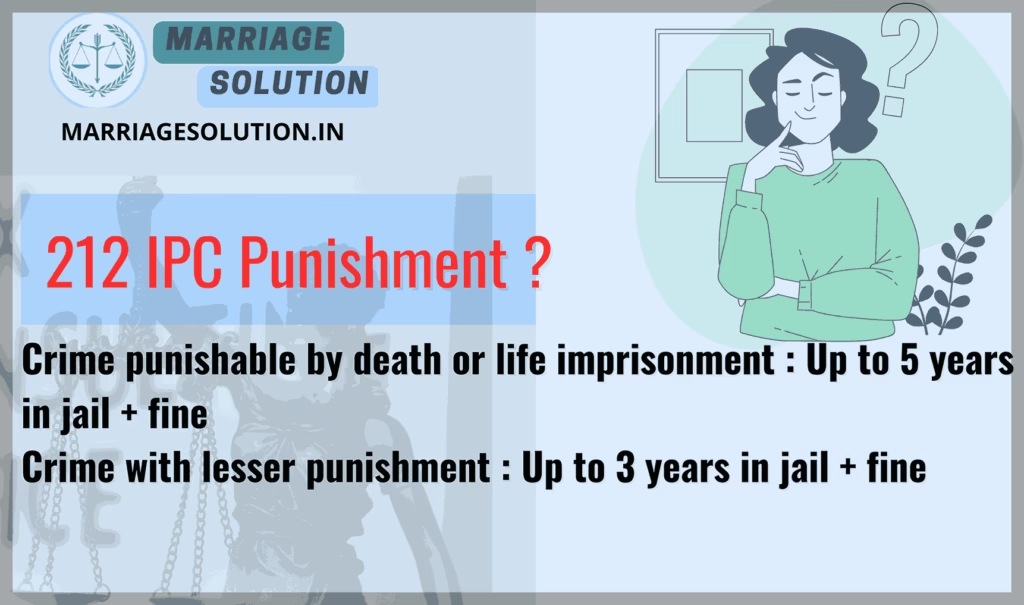
| Crime punishable by death or life imprisonment | Up to 5 years in jail + fine |
| Crime with lesser punishment | Up to 3 years in jail + fine |
212 IPC Bailable or non bailable
- If the main crime is punishable with death or life imprisonment → Non-bailable (harder to get bail).
- If the main crime has lesser punishment → Bailable (easier to get bail).
Section 212 IPC in short information
| IPC Section | Offense | Punishment | Bailable/Non-Bailable | Cognizable/Non-Cognizable | Trial By |
|---|---|---|---|---|---|
| IPC 212 | Harbouring an offender (helping a criminal escape arrest/punishment) | Up to 5 years in jail + fine (for serious crimes), Up to 3 years in jail + fine (for lesser crimes) | Non-bailable (for serious crimes), Bailable (for lesser crimes) | Cognizable (for serious crimes), Non-cognizable (for lesser crimes) | Magistrate or Sessions Court (depending on severity) |
IPC Section 212 FAQs
What is IPC Section 212?
IPC 212 punishes anyone who deliberately helps a criminal escape arrest or punishment by hiding them, giving them shelter, money, or misleading the police.
Is IPC 212 a serious offense?
Yes, it is a serious offense, especially when the main crime is punishable by death or life imprisonment.
Can family members be punished under IPC 212?
Close family members have some protection but may still be punished if they actively help in the escape.
What is the punishment under IPC 212?
If the main crime has lesser punishment → Up to 3 years in jail + fine.
If the main crime is punishable by death or life imprisonment → Up to 5 years in jail + fine.
Is IPC 212 bailable or non-bailable?
If the main crime is less serious → Bailable.
If the main crime is very serious (death/life imprisonment) → Non-bailable.
If you need support with court proceedings or any other legal matters, don’t hesitate to reach out for assistance.
Court or any other marriage-related issues, our https://marriagesolution.in/lawyer-help-1/ website may prove helpful. By completing our enquiry form and submitting it online, we can provide customized guidance to navigate through the process.