
Introduction to Section 110 BNSS / Cross-State and International Summons & Warrants
Section 110 BNSS, 2023, establishes procedures for the service and execution of legal documents—such as summonses and warrants—across different jurisdictions. This provision facilitates cooperation between courts within India and with foreign countries that have reciprocal arrangements, ensuring the seamless administration of justice beyond local boundaries.
What is BNSS Section 110 ?
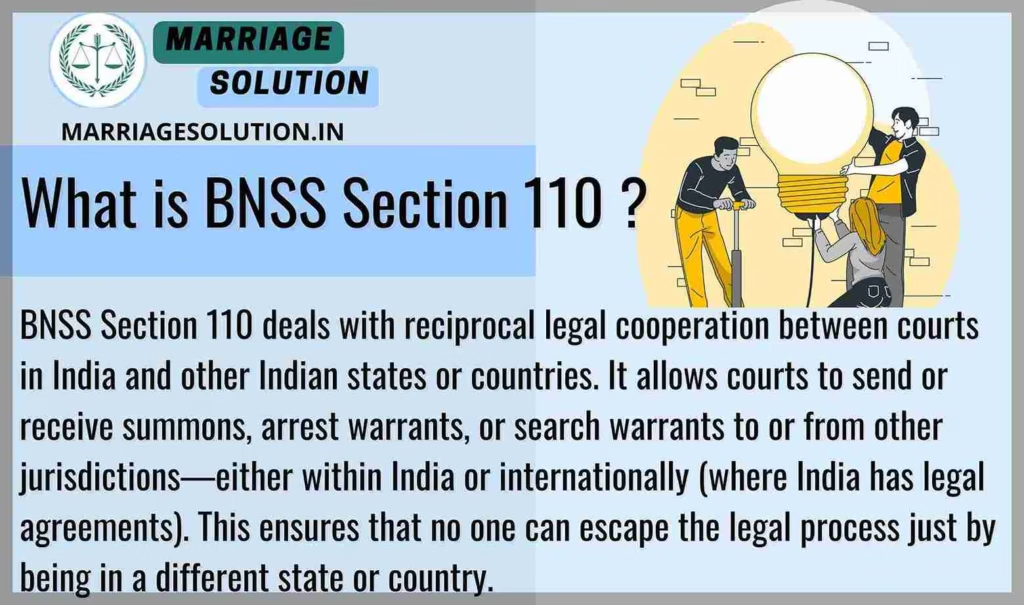
BNSS Section 110 deals with reciprocal legal cooperation between courts in India and other Indian states or countries. It allows courts to send or receive summons, arrest warrants, or search warrants to or from other jurisdictions—either within India or internationally (where India has legal agreements). This ensures that no one can escape the legal process just by being in a different state or country.
BNSS Section of 110 in Simple Points
1. Power to Send Summons or Warrants Across India
When a court in one part of India wants to serve a summons or arrest warrant to someone in another Indian state (outside its own jurisdiction), it can do so under this section. The document is sent in duplicate (two copies) by post or other methods to the court in the other state. That local court will serve or execute it just like it would do for its own cases. This makes sure that legal action is not restricted by state boundaries.
2. International Execution of Legal Documents
If the person or evidence is located in a foreign country that has a mutual legal assistance agreement with India (called a “contracting state”), the Indian court can send legal documents there. These documents (like a search warrant or summons) are sent in a specific form and through authorities notified by the Central Government. This makes it possible to take legal action against someone who has fled to another country or when important evidence is located outside India.
3. Types of Legal Documents Covered
Section 110 covers several important legal documents. These include:
- Summons to an accused person,
- Arrest warrants,
- Summons to a person to produce a document or thing,
- Search warrants.
This section helps courts carry out investigation and prosecution effectively, even if the person or item needed is outside their direct reach. It ensures legal continuity without delays.
4. Receiving and Executing Documents from Other Courts
Just like Indian courts can send legal documents to other states or countries, they can also receive such documents. For example, if a court in another Indian state or a foreign country sends a warrant to an Indian court, the Indian court must treat it as if it was issued locally and act on it accordingly. Arrested persons must be handled as per Indian procedure (Sections 82 and 83), and items found during a search must follow Section 104.
5. Central Government’s Role in International Cases
In international cases, the Central Government plays a very important role. It decides and notifies which foreign authorities will receive Indian summons or warrants. It also decides through which authority the documents or items found during an international search will be returned to India. This ensures that such international cooperation follows a proper legal and diplomatic process, maintaining both effectiveness and legality.
Section 110 of BNSS Overview
BNSS Section 110 empowers courts to issue and execute legal processes like summonses and warrants outside their local jurisdiction. It outlines mechanisms for inter-state and international cooperation, enabling courts to collaborate effectively with other jurisdictions. This section ensures that legal proceedings are not hindered by geographical limitations, promoting efficiency and uniformity in the judicial process.
10 Key Points of BNSS Section 110
1. Inter-State Legal Cooperation Within India
BNSS Section 110 allows a court to send legal documents like summonses or warrants to another court located in a different state or region of India. This means that if a person is outside the local area of the court, legal documents can still be sent and acted upon. The court simply sends these documents to the presiding officer of another court by post or other approved methods. This process ensures that court orders are not limited by borders within India. It helps to prevent accused persons or witnesses from escaping legal responsibilities by moving to another state. The receiving court treats the documents as if it had issued them itself. This cooperation between courts helps in smooth legal functioning.
2. Enabling International Legal Support
If the person or document to be served is outside India, Section 110 provides a way to send the necessary legal documents to other countries. However, this is allowed only if India has a mutual legal agreement (called a reciprocal arrangement) with that country. The court sends the documents in a proper format, as notified by the Central Government. These are addressed to the proper legal authority in that foreign country. This provision helps Indian courts seek justice even when someone involved is residing abroad. It is an important tool in criminal investigations involving international elements.
3. Four Types of Legal Documents Covered
Section 110 clearly outlines which types of legal documents can be sent to other jurisdictions. These are: (a) a summons to an accused person, (b) a warrant for the arrest of an accused person, (c) a summons for the production of documents or other things, and (d) a search warrant. By covering these major types of legal documents, the section ensures that courts have the necessary tools to deal with different stages of investigation or trial. This helps in collecting evidence, securing the presence of the accused or witness, and enforcing the law even beyond one’s local court area.
4. Central Government’s Role in International Cases
In cases involving foreign countries, the Central Government has a major role. It decides which countries India can send legal documents to, and through which legal channel. The court cannot directly send a summons or warrant to a foreign country; instead, it must follow the route set by the Central Government. This ensures that legal procedures match international standards. The Government also specifies the form of the documents and the legal authorities to handle them abroad. This step maintains diplomatic balance and smooth legal communication between countries.
5. Execution of Received Documents from Other Courts
Just like Indian courts can send legal documents to other areas, they can also receive them from courts in other states or from courts in countries that have arrangements with India. When such documents are received, the local court must treat them as if they were issued by itself. This ensures that orders from other courts are respected and executed quickly. It also creates a uniform procedure for handling such cases, so that there’s no delay or confusion in executing legal orders from other places.
6. Procedure for Handling Arrested Persons
If a person is arrested under a warrant received from another Indian court or from a foreign country, he or she must be dealt with according to Sections 82 and 83 of the BNSS. These sections explain the proper procedures after an arrest is made. This ensures that the person’s legal rights are protected and that the arrest is not misused. The arrested person can be produced before a magistrate and further steps can be taken according to the law. This provides fairness while still allowing effective legal action.
7. Procedure for Handling Search Warrants
When a search warrant is received and executed, the items found during the search must be handled according to Section 104 of the BNSS. This section deals with how evidence and seized property should be managed. It ensures the items are properly recorded, sealed, and sent for further legal action. This prevents tampering and protects the chain of custody. If the warrant came from a foreign country, the items found are sent back to the country through the legal channel notified by the Central Government.
8. Ensuring Uniformity and Fairness
BNSS Section 110 makes sure that all courts, whether in one state or another, or even in different countries (with agreements), follow the same procedures while dealing with legal documents. It avoids confusion and duplication of effort. More importantly, it ensures that no one can escape justice simply by crossing a border. This uniformity helps maintain public trust in the legal system and makes legal enforcement stronger and more reliable across regions.
9. Safe Transmission of Legal Evidence
When items or documents are found during a search conducted under this section, they are not simply handed over directly. Instead, they are sent back to the court that issued the search warrant through a designated authority. This prevents misuse or loss of important legal materials. The Central Government’s notification ensures a trusted chain of custody. This secure and authorized process helps maintain the value and legality of the evidence.
10. Supports National and Global Legal Cooperation
This section plays a vital role in enhancing cooperation between Indian states and with foreign governments. It ensures that India is ready to handle legal matters that span across borders, whether national or international. With crime and technology evolving globally, this type of legal provision ensures that Indian courts are not powerless when someone involved is located in another state or country. It brings confidence to victims and investigators that the law will reach everywhere justice is needed.
Example 1: Inter-State Summons Service
A court in Delhi issues a summons for an accused who has shifted to Bangalore (Karnataka). Under BNSS Section 110, the Delhi court can send the summons to the Bangalore court. The Bangalore court serves it to the accused just like a local case. This ensures legal action is not blocked due to location change within India.
Example 2: International Arrest Warrant Execution
An Indian court issues an arrest warrant for a person who has fled to the UK. Since India has a legal agreement with the UK, the court sends the warrant through proper channels as notified by the Central Government. The UK authorities can then arrest and deport or present the person as per the agreement.
Section 110 of BNSS Short Information
| Key Point | Description |
|---|---|
| Inter-state Service | A court can send summons or warrants to another Indian state; the receiving court will serve or execute them locally. |
| International Cooperation | If a country has a reciprocal agreement with India, documents can be sent abroad via channels notified by the Central Government. |
| Documents Covered | Covers summons to accused, arrest warrants, production orders for documents/things, and search warrants. |
| Central Government Role | Central Government specifies foreign authorities and the proper form and channel for sending international legal documents. |
| Execution of Received Orders | Courts receiving documents from other states or contracting countries must treat and execute them as if issued locally, following BNSS procedures. |
| Safeguards and Return of Evidence | Items found abroad or in another state are handled per Section 104 and returned via the notified channel to preserve chain of custody. |
BNSS Section 110 FAQs
BNSS 110
Conclusion
BNSS Section 110 is an important step toward unified and borderless justice. It allows Indian courts to send and execute legal documents like summonses and warrants across states and even internationally (where agreements exist). By involving the Central Government in global cooperation and maintaining clear procedures, this section ensures that legal actions remain effective, fair, and respected across jurisdictions. It prevents accused persons or evidence from escaping the reach of justice, ensuring a strong and connected legal system.
Need Legal Support?
If you are dealing with court cases, marriage problems, or any other legal issue, our team at Marriage Solution – Lawyer Help is here for you. Simply fill out our quick online enquiry form, and we’ll connect you with the right legal expert to support your needs .
Finished with BNSS Section 110 ? Continue reading the next sections of the Bharatiya Nagarik Suraksha Sanhita (BNSS), 2023. Each section is explained in easy words, with simple examples, so anyone can understand it clearly.
- Section 111 BNSS : Assistance in Criminal Cases and Property Seizure.
- Section 112 BNSS : Investigate Crimes Across Borders.
- Section 113 BNSS : Foreign Request for Evidence or Investigation in India.
- Section 114 BNSS : Transfer of Accused Across Borders .
Full BNSS Section List: https://marriagesolution.in/bnss_section-list/
Full BNS Section List: https://marriagesolution.in/bharatiya-nyaya-sanhita-section-list/
Full IPC Section List: https://marriagesolution.in/ipc-section-list
All Indian Law & Blogs: https://marriagesolution.in/indian-law/
Need Legal Help? Speak to an Experienced Lawyer Now.

Court Marriage in India: Complete Process, Timeline & Inter-Caste Incentives
More couples in India are choosing court marriage over traditional ceremonies every year — whether for simplicity, personal choice, or the legal recognition it provides without the scale of a full wedding. A court marriage is like a legal love…

Right to Information RTI act :Your Comprehensive Guide (Part 1)
The Right to Information (RTI) Act : Explore the essence of the Right to Information (RTI) Act through this symbolic image. The image features legal documents, emphasizing the importance of transparency and accountability in governance. The scales of justice represent…

What is Article 371 of Indian Constitution ?
Article 371 of the Indian Constitution grants special provisions to specific states and regions within India, addressing their unique historical, social, and cultural circumstances. These provisions aim to accommodate diverse needs and protect cultural identities within the constitutional framework.

Indian Labour law : Your Comprehensive Guide (Part 1)
The purpose of labour laws is to safeguard employees and guarantee equitable treatment at the workplace, encompassing aspects such as remuneration, security, and perks. These regulations establish a secure ambiance by imposing minimum wage requirements, ensuring factory safety measures are…