
Introduction to Section 235 BNSS
Section 235 BNSS is a crucial legal provision that focuses on the particulars required in framing charges against an accused. It ensures that every charge clearly mentions the time, place, and persons involved in the alleged offence, giving the accused proper notice. This section is especially important in cases involving criminal breach of trust or dishonest misappropriation, allowing charges to cover a range of dates and values without specifying every detail, thereby facilitating efficient prosecution.
What is BNSS Section 235 ?
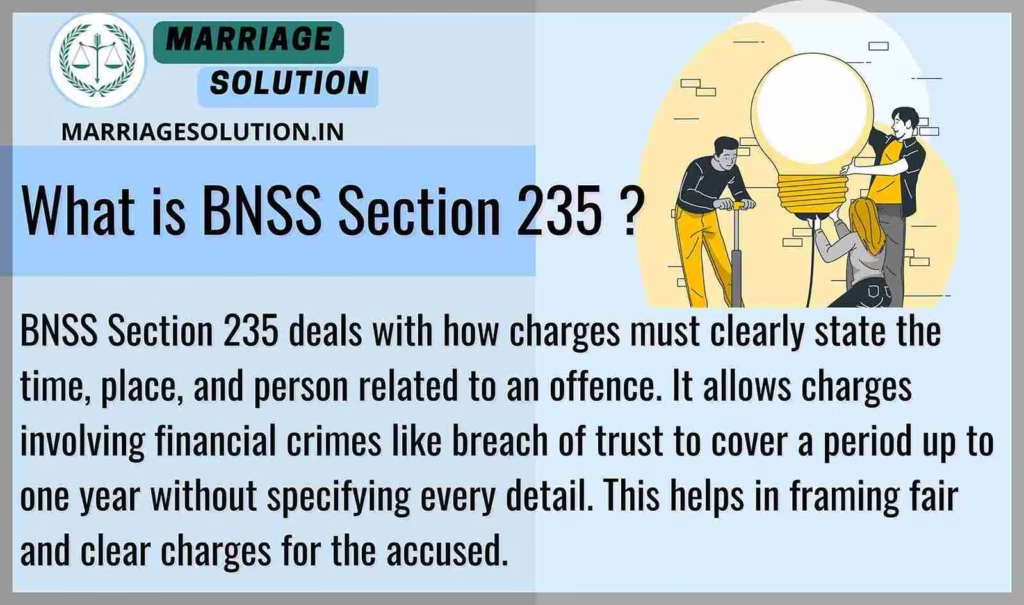
BNSS Section 235 deals with how charges must clearly state the time, place, and person related to an offence. It allows charges involving financial crimes like breach of trust to cover a period up to one year without specifying every detail. This helps in framing fair and clear charges for the accused.
BNSS Section of 235 in Simple Points
1. Clarity of Time, Place, and Person in Charges
BNSS Section 235 mandates that the charge against the accused should clearly mention when and where the offence happened. It must also identify the person involved or the property concerned. This clarity ensures that the accused understands the charge fully and can prepare an adequate defense. The particulars must be sufficient but need not be overly detailed, balancing fairness with practicality.
2. Charges Covering a Range of Dates
In cases involving criminal breach of trust or misappropriation, the law allows the charge to specify a time range instead of exact dates. The range cannot exceed one year. This flexibility acknowledges that financial offences often happen over time and exact details may not be easily pinpointed. It enables the prosecution to charge the accused for the whole period without breaking it down unnecessarily.
3. Single Offence Treatment under Section 242
Even if the charge mentions multiple acts occurring within the date range, BNSS 235 treats the entire charge as a single offence under Section 242. This prevents the accused from facing multiple charges for related acts, which could complicate the trial. It simplifies legal proceedings while maintaining the seriousness of the offence.
4. Correction and Alteration of Charges
The section provides for the possibility of correcting or altering charges if mistakes or omissions are found. This ensures the charges remain accurate and fair throughout the trial. Additionally, witnesses can be recalled after these changes to give evidence relevant to the revised charges, safeguarding the rights of both the accused and the prosecution.
5. Joinder and Trial of Multiple Related Offences
BNSS 235 allows related offences committed within the specified period to be joined and tried together. This is particularly useful when several offences form part of the same transaction or series of connected acts. It promotes judicial efficiency, saving time and resources, and ensures that the accused faces a comprehensive trial covering all relevant offences at once.
Section 235 of BNSS Overview
BNSS Section 235 outlines how charges should be framed when exact dates or details of an offence are unclear or involve multiple instances within a period. It allows specifying a date range, not exceeding one year, within which the offence occurred. The section treats such a charge as a single offence under Section 242. Moreover, it provides guidelines on the contents of a charge, the possibility of altering charges, recalling witnesses, and trying multiple connected offences together to ensure judicial efficiency.
BNSS Section 235 – 10 Key Points
- Particulars of Time, Place, and Person in the Charge
BNSS Section 235 requires that every charge must clearly state the time and place of the alleged offence. It should also identify the person against whom the offence was committed or the thing involved if applicable. These particulars must be reasonably sufficient to inform the accused about the exact nature of the charge, enabling them to prepare their defense properly. - Charges Involving Criminal Breach of Trust or Misappropriation
When the offence involves criminal breach of trust or dishonest misappropriation of money or movable property, the charge does not have to specify each item or exact date. Instead, it is enough to mention the gross sum involved or describe the property and the period during which the offence occurred. This flexibility simplifies charges related to complex financial crimes. - Time Limit on Offence Period
The time frame specified between the first and last date of the alleged offence should not exceed one year. This restriction ensures that charges remain specific and avoid unnecessarily long periods, which could be unfair to the accused and complicate the judicial process. - Charge as a Single Offence Under Section 242
Even if the charge covers a range of dates or multiple acts, the entire charge is considered one offence under Section 242 of BNSS. This legal provision prevents the proliferation of multiple charges for what is essentially a continuous or related criminal conduct. - Essential Contents of the Charge
The charge must include the accused’s name, the relevant section of law, any previous convictions, and the details of time, place, and persons involved. Including these particulars ensures transparency and clarity, reducing the chances of confusion or errors during the trial. - Description of the Manner of Offence
Section 235 also emphasizes that the charge should clearly state the manner or method in which the offence was committed. This helps in establishing the factual context, allowing the court to understand the nature and gravity of the offence. - Correction and Alteration of Charges
If errors or omissions are discovered in the charge, the section allows for alterations to be made. Witnesses may also be recalled after such changes. This ensures that the charge accurately reflects the facts without prejudicing the accused’s rights. - Joinder of Charges for Efficiency
Charges for separate but related offences committed within a year can be joined and tried together under this section. This provision reduces multiple trials, saving time and resources for both the judiciary and the parties involved. - Trial of Multiple Connected Offences
If several offences arise from acts that form the same transaction, the accused can be charged and tried for all offences in one trial. This avoids splitting connected offences into separate trials, promoting judicial efficiency and comprehensive judgment. - Alternative Charging in Cases of Doubt
When it is unclear which offence the facts might constitute, the accused may be charged alternatively with several offences. Any number of such charges can be tried at once, or the accused may be tried for one offence in the alternative, protecting both the prosecution’s case and the accused’s rights.
Example 1:
A businessman is accused of embezzling funds from his company multiple times between April 2023 and December 2023. Since the exact dates and amounts of each transaction are not fully documented, the charge under Section 235 mentions the total amount embezzled and the date range without specifying each act separately.
Example 2:
An individual allegedly committed theft of electronic items from a warehouse between January 2024 and June 2024. The charge names the items stolen collectively and the entire period during which the thefts happened, allowing the prosecution to treat these multiple thefts as one offence under Section 235.
Section 235 of BNSS Short Information
| Key Point | Simple Explanation |
|---|---|
| 1. Clarity of Time, Place, and Person | Each charge must clearly mention when and where the offence took place and who was involved. This helps the accused understand the case properly and prepare their defence. |
| 2. Charges for Financial Crimes | In cases like criminal breach of trust or misappropriation, the charge can include a time range (up to one year) instead of exact dates for each act, making it easier to handle such cases. |
| 3. Treated as One Offence | When multiple acts happen within that time period, they are treated as one single offence under Section 242 to avoid repeated trials for related actions. |
| 4. Correction or Alteration Allowed | If there are any mistakes or missing details in the charge, the court can correct or alter it later. Witnesses can also be recalled if needed after such changes. |
| 5. Joint Trial for Related Offences | When several related offences occur within a year, they can be combined and tried together, saving time and ensuring a complete and fair trial process. |
BNSS Section 235 FAQs
BNSS 235
Conclusion
BNSS Section 235 ensures that every criminal charge is framed with clear and sufficient details like time, place, and the people involved. It simplifies the process for financial and continuous offences by allowing a one-year time range and treating multiple related acts as a single offence. This section helps prevent confusion, promotes fairness, and supports efficient court procedures while protecting the rights of the accused.
Need Legal Support?
If you are dealing with court cases, marriage problems, or any other legal issue, our team at Marriage Solution – Lawyer Help is here for you. Simply fill out our quick online enquiry form, and we’ll connect you with the right legal expert to support your needs .
Finished with BNSS Section 235 ? Continue reading the next sections of the Bharatiya Nagarik Suraksha Sanhita (BNSS), 2023. Each section is explained in easy words, with simple examples, so anyone can understand it clearly.
- Section 236 BNSS : Manner of Committing Offence
- Section 237 BNSS : Understanding Legal Meanings in Charges.
- Section 238 BNSS : Effect of Errors in a Charge .
- Section 239 BNSS : Courts Ensure Justice Through Charge Corrections .
Full BNSS Section List: https://marriagesolution.in/bnss_section-list/
Full BNS Section List: https://marriagesolution.in/bharatiya-nyaya-sanhita-section-list/
Full IPC Section List: https://marriagesolution.in/ipc-section-list
All Indian Law & Blogs: https://marriagesolution.in/indian-law/
Need Legal Help? Speak to an Experienced Lawyer Now.

Right to Information RTI act :Your Comprehensive Guide (Part 1)
The Right to Information (RTI) Act : Explore the essence of the Right to Information (RTI) Act through this symbolic image. The image features legal documents, emphasizing the importance of transparency and accountability in governance. The scales of justice represent…

What is Article 371 of Indian Constitution ?
Article 371 of the Indian Constitution grants special provisions to specific states and regions within India, addressing their unique historical, social, and cultural circumstances. These provisions aim to accommodate diverse needs and protect cultural identities within the constitutional framework.
Indian Labour law : Your Comprehensive Guide (Part 1)
The purpose of labour laws is to safeguard employees and guarantee equitable treatment at the workplace, encompassing aspects such as remuneration, security, and perks. These regulations establish a secure ambiance by imposing minimum wage requirements, ensuring factory safety measures are…

GST :Your Comprehensive Guide (Part 1 – Understanding the Basics)
The Goods and Services Tax (GST) is like a big change in how we pay taxes in India. It started on July 1, 2017, and it’s here to simplify things. Before GST, we had many different taxes, and it could…