
Introduction to Section 385 BNSS
Section 385 BNSS plays a vital role in ensuring that serious acts of contempt in courtrooms are dealt with through proper legal channels. While BNSS 384 allows summary punishment for minor misconduct in court, some contemptuous acts may be too severe for that route. In such cases, Section 385 empowers the court to forward the case to a Magistrate for regular trial and appropriate punishment. This provision maintains a balance between courtroom authority and legal due process, upholding justice.
Table of Contents
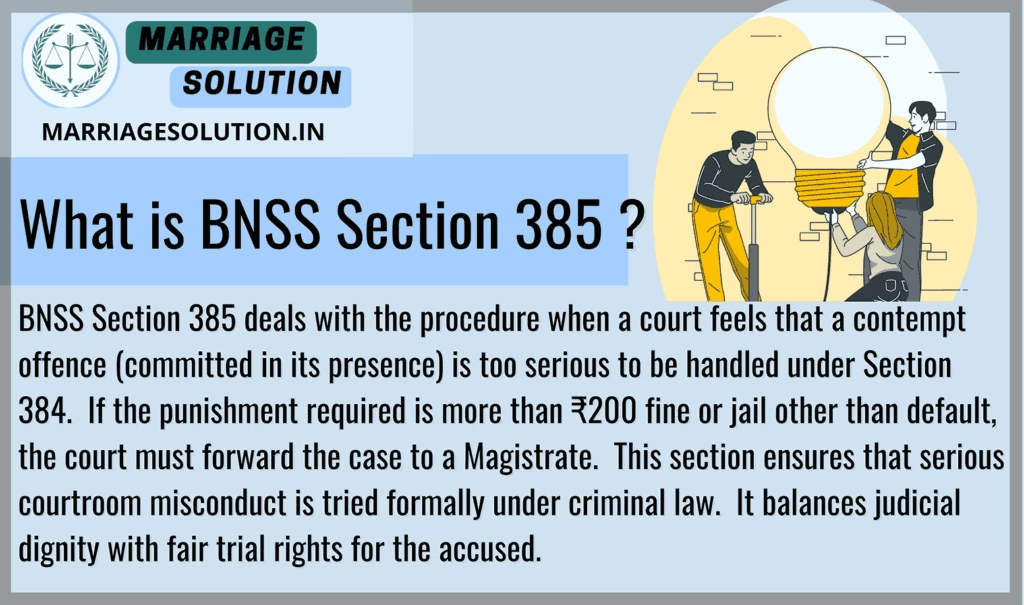
What is BNSS Section 385?
BNSS Section 385 contains two main sub-sections:
- Sub-section (1) allows the court to transfer a contempt case to a Magistrate if it feels a fine over ₹200 or imprisonment beyond default is necessary. The court must record the offence and the accused’s statement, then forward the case.
- Sub-section (2) states that once forwarded, the Magistrate should deal with it as if it were instituted on a police report, meaning full trial procedures will follow.
This provision ensures fair handling of serious contempt incidents.
BNSS Section of 385 in Simple Points
1. When Is Section 385 Invoked?
BNSS 385 comes into play when a person commits a contemptuous act in court that is too grave for a summary punishment under Section 384. If the judge feels that the accused deserves a fine above ₹200, or imprisonment not just in default of fine, they must not pass the sentence directly. Instead, the court must initiate a more serious legal process by transferring the case. This ensures that minor and major contempt offences are handled differently, with proper legal weight given to the severity of the action.
2. Court Must Record Facts and Statement
Before forwarding the matter to a Magistrate, the court is required to record the details of the offence as observed. It must also record the accused’s statement or explanation, as per earlier provisions. This documentation acts as a foundation for the next level of proceedings. It ensures that no one is referred to trial without proper justification or evidence. This also maintains procedural transparency and ensures that both the prosecution and defense have clarity on what happened.
3. Forwarding to Magistrate and Legal Path
If the court finds the case unsuitable for summary disposal, it can forward the case to a Magistrate who has jurisdiction. The Magistrate then proceeds as though the case had been filed via police report, invoking regular criminal trial rules. The original court can also demand security for the accused’s appearance, or send them in custody if such security is not given. This marks the transition from courtroom control to judicial trial, ensuring fair treatment but not letting the act go unpunished.
4. Why Some Cases Require Formal Trial
Certain acts of contempt are not just disrespectful—they could be intimidating, obstructive, or abusive, which directly threaten judicial authority. A simple ₹1000 fine or one-month jail (as in Section 384) may not act as a deterrent for such serious behaviour. BNSS 385 exists to escalate these serious acts into a structured trial, ensuring a proper investigation, legal representation, and full hearing. This protects not just the dignity of courts but also reinforces public trust in the legal fairness.
5. Ensuring Balance Between Power and Justice
While courts must maintain order, they also have a duty to ensure natural justice and fair trial. BNSS 385 ensures this balance by empowering the court to act, but also requiring it to respect due process. It is not a tool for immediate punishment, but for judicial escalation where needed. This provision safeguards the rights of the accused, and ensures that serious misconduct is not treated too lightly, nor too harshly without trial. It is an example of the law’s maturity and fairness.
385 BNSS Overview
BNSS 385 empowers a court to escalate contempt cases beyond summary proceedings when it finds the offence too serious for simple fine or imprisonment. If the judge believes that the accused deserves greater punishment than what is permissible under Section 384, or for any other valid reason, the case can be forwarded to a Magistrate. The Magistrate will then treat it like a regular criminal case. The court can also demand security or custody of the accused until their appearance before the Magistrate.
BNSS Section 385 – Procedure Where Court Considers Case Should Not Be Dealt With Under Section 384
(Chapter XXVIII – Offences Affecting the Administration of Justice)
1. Purpose of BNSS Section 385
BNSS Section 385 is designed to handle situations where a contempt offence, committed in the court’s view or presence, is too serious to be handled under Section 384. While Section 384 allows for summary punishment like a fine or short imprisonment, some cases may warrant stricter penalties. In such scenarios, this section empowers the court to transfer the case to a Magistrate for regular trial. It ensures that serious contempt is not lightly dealt with and the gravity of the act is properly addressed.
2. Situations When Section 385 Applies
Section 385 applies when the court believes that the contempt committed needs imprisonment beyond default of fine, or a fine exceeding ₹200, or for any other reason, the case shouldn’t be handled summarily under Section 384. This reflects the court’s discretion to treat each contempt case differently, based on its severity. Some misconducts may be too grave or repeated, warranting a full criminal process rather than a quick penalty. The law thus ensures that punishment fits the seriousness of the act.
3. Requirement to Record Offence Details
Before transferring the case, the court must record the facts constituting the offence and the statement of the accused, just as in Section 384. This documentation ensures fairness and transparency before the matter is passed to a Magistrate. It also forms the basis of the new proceeding and helps the Magistrate understand the background clearly. Such records avoid any misuse of power and protect the accused’s legal rights while ensuring justice is upheld.
4. Transfer to Magistrate with Jurisdiction
Once the decision is made, the court may forward the case to a Magistrate who has the jurisdiction to try such offences. The accused can either be granted bail/security for appearance or, if unable to provide it, can be sent in custody. This ensures that the individual is properly brought before the appropriate judicial authority. It also marks the end of the court’s summary jurisdiction under Section 384 and the beginning of a formal legal process through trial.
5. Why Summary Punishment May Not Suffice
Some contempt acts may involve physical threats, violent disruption, or repeated insults to judicial authority. In such instances, a ₹1000 fine or one-month simple jail may be inadequate punishment. Section 385 thus enables escalation to regular criminal procedure, where full trial, evidence, and appropriate sentencing can follow. This acts as a deterrent against more serious offences and upholds respect for the judicial institution. It also reflects the justice system’s flexibility and balance.
6. Legal Continuity with Police Report Procedure
Once the case is transferred, the Magistrate must deal with the matter as if it were instituted on a police report. This means the regular procedure for criminal trials will apply, ensuring investigation, framing of charges, hearing of witnesses, and final judgment. Though the offence happened in court’s view, it is now processed under the standard criminal justice system. This ensures no compromise on legal procedure, and also reinforces the idea that courts are bound by law even in contempt matters.
7. Role of Court’s Discretion and Fairness
BNSS Section 385 reflects the Indian legal system’s trust in the judicial discretion of the presiding officer. The judge must evaluate whether the contempt offence is truly minor or deserving of full-scale judicial scrutiny. The decision is not automatic—it involves careful assessment of facts, behavior, and intent. This maintains a fine balance between protecting court authority and safeguarding individual liberty. Judges are expected to use this power responsibly, with fairness and proportionality.
8. Protection for the Accused
Even though the offence is committed in court’s presence, the accused is not denied procedural fairness. If the case is considered serious under Section 385, the person gets the opportunity for a full trial where evidence will be examined and legal defense allowed. This safeguards the individual’s constitutional rights and protects against excessive or unjust punishment. Thus, BNSS 385 not only supports court dignity but also ensures justice is not delivered in haste or bias.
9. Support for Judicial Discipline
By allowing serious contempt cases to be dealt with under standard law, BNSS 385 reinforces that judicial proceedings are sacred and must be respected. It acts as a back-up mechanism when the summary process of Section 384 is insufficient. Judges are thus not helpless when dealing with disruptive elements in court. This strengthens the public perception of courts as disciplined, structured, and fair institutions that take misconduct seriously but handle it lawfully.
10. Conclusion – The Role of BNSS 385 in Modern Judiciary
In modern-day courts, especially in high-pressure environments, contemptuous behavior can hinder the process of justice. BNSS Section 385 serves as an important legal provision to escalate contempt matters when summary justice is not enough. It ensures that serious disruptions are dealt with through proper judicial trial, while protecting the rights of the accused. Together with Section 384, it completes the framework to address courtroom misconduct—from minor to major violations—ensuring justice with dignity, discipline, and due process.
Example 1: Threatening a Judge in Open Court
During a bail hearing, an accused person openly threatens the judge, saying he will “teach them a lesson outside.” The judge feels the act is too severe for a ₹1000 fine, and under BNSS 385, forwards the case to a Magistrate for criminal trial under proper procedure.
Example 2: Physical Obstruction of Court Proceedings
In a land dispute case, a party brings outsiders to block court functioning and causes chaos. As this is a serious and intentional disruption, the judge uses BNSS 385 to escalate the matter to a competent Magistrate instead of handling it summarily under Section 384.
BNSS Section 385 Short Information
| Point | Details |
|---|---|
| Section Name | BNSS Section 385 – Procedure Where Court Considers Case Should Not Be Dealt With Under Section 384 |
| Purpose | Allows courts to forward serious contempt cases to a Magistrate when summary punishment under Section 384 is inadequate. |
| When Applied | Used when the offence deserves higher punishment than a ₹1000 fine or one month’s jail, or requires full criminal procedure. |
| Court’s Duty | Court must record offence facts, offender’s statement, and then send the case to a competent Magistrate with custody or security orders. |
| Magistrate’s Role | Magistrate handles the case like a regular criminal trial (as if on a police report), ensuring full due process and fair hearing. |
Why BNSS 385 Is Needed ?
BNSS Section 385 is crucial to address instances where contempt of court is too serious for quick penalties. Situations such as threats to judges, violent behaviour in the courtroom, or gross abuse must be treated with the seriousness they deserve. Section 384 allows only minor fines or jail in default, which may not deter such grave acts. BNSS 385 fills this gap by shifting the matter to a Magistrate for full legal proceedings, ensuring that justice is done properly. This protects the authority of courts while also preserving the legal rights of the accused through formal procedures, evidence, and trial.
BNSS Section 385 FAQs
Q1: What is BNSS 385 in simple terms?
BNSS 385 allows a court to forward serious contempt cases to a Magistrate for trial instead of handling them with simple fines or summary imprisonment.
Q2: When is BNSS 385 used instead of Section 384?
When the contempt offence requires a higher punishment, like a fine above ₹200 or imprisonment other than default, BNSS 385 is invoked.
Q3: Does BNSS 385 allow custody of the accused?
Yes, under BNSS 385, the court can require security or send the person in custody to the Magistrate if bail is not secured.
Q4: Is a trial mandatory under BNSS 385?
Yes. Once transferred, the Magistrate will conduct a regular criminal trial as per procedure applicable to police-reported cases.
Q5: Why is BNSS 385 important in legal procedure?
BNSS 385 ensures that serious courtroom misconduct is not lightly punished and follows full judicial process, maintaining respect for the judiciary.
Conclusion
BNSS Section 385 allows courts to send serious contempt cases to a Magistrate for a full trial when a small fine or short jail term is not enough. It ensures fair treatment for the accused while maintaining the court’s authority and discipline.
Need Legal Support?
If you are dealing with court cases, marriage problems, or any other legal issue, our team at Marriage Solution – Lawyer Help is here for you. Simply fill out our quick online enquiry form, and we’ll connect you with the right legal expert to support your needs .
Finished with BNSS Section 385 ? Continue reading the next sections of the Bharatiya Nagarik Suraksha Sanhita (BNSS), 2023. Each section is explained in easy words, with simple examples, so anyone can understand it clearly.
- Section 386 BNSS : Registrar or Sub-Registrar as Civil Court .
- Section 387 BNSS : Releasing an Offender Upon Offering an Apology .
- Section 388 BNSS : Legal Action Against Individuals Who Decline to Answer or Provide Evidence .
- Section 389 BNSS : Quick legal process for punishing witness absent despite summons .
Full BNSS Section List: https://marriagesolution.in/bnss_section-list/
Full BNS Section List: https://marriagesolution.in/bharatiya-nyaya-sanhita-section-list/
Full IPC Section List: https://marriagesolution.in/ipc-section-list
All Indian Law & Blogs: https://marriagesolution.in/indian-law/