
Introduction to Section 283 BNSS
BNSS Section 283 is about the summary trial of minor criminal cases. It gives powers to Chief Judicial Magistrates and First Class Magistrates to hear small cases quickly without going through the full, lengthy trial process. This helps courts save time and provides quick justice in cases like petty theft, criminal intimidation, and minor cheating. The value of property involved in such cases should usually not exceed ₹20,000.
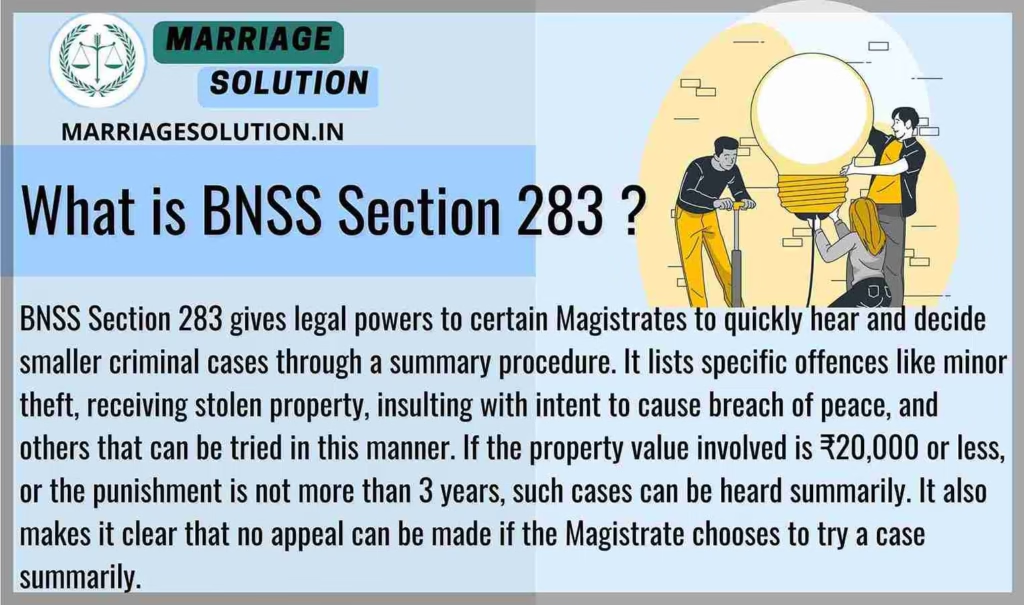
What is BNSS Section 283 ?
BNSS Section 283 gives legal powers to certain Magistrates to quickly hear and decide smaller criminal cases through a summary procedure. It lists specific offences like minor theft, receiving stolen property, insulting with intent to cause breach of peace, and others that can be tried in this manner. If the property value involved is ₹20,000 or less, or the punishment is not more than 3 years, such cases can be heard summarily. It also makes it clear that no appeal can be made if the Magistrate chooses to try a case summarily.
BNSS Section of 283 in Simple Points
1. Meaning of Summary Trials under BNSS 282
BNSS Section 282 explains how summary trials should be conducted by Magistrates. A summary trial is a quick and simple court process used to decide minor criminal cases. This section ensures that the trial is fair even though it’s faster than a normal trial. Summary trials help courts to deal with petty offences without wasting time. Even in summary trials, important court procedures must still be followed properly for justice.
2. Magistrates Who Can Conduct Summary Trials
BNSS 282 gives power to Chief Judicial Magistrates, First Class Magistrates, and in certain cases, Second Class Magistrates to conduct summary trials. These Magistrates can only handle summary trials for offences allowed by law or approved by the State Government. This system ensures that only experienced judges are handling even the minor cases, giving confidence to the people that their matter is being handled properly.
3. Procedure for Summary Trials under BNSS 282
While conducting summary trials, BNSS 282 makes sure the basic rights of the accused are protected. The record of the trial should include important details like the offence, evidence, arguments, and the judgment. The entire process must be simple but proper, without missing out on fairness. This keeps the trial short but ensures that no injustice is done to the accused or the victim.
4. Language of Judgment in Summary Trials
BNSS 282 also mentions that the judgment in summary trials should be recorded in the language of the court. This helps everyone understand the decision easily. Using local languages for judgments ensures transparency. When the judgment is written clearly and in an understandable language, it builds trust between the court and the common people.
5. Importance of BNSS 282 in Justice System
BNSS 282 helps Indian courts handle thousands of petty cases that would otherwise take up unnecessary time. By allowing certain Magistrates to quickly decide simple cases, the court can focus more on serious crimes. This balance helps both—people get quicker justice for small matters, and courts save time for major cases. Overall, BNSS 282 strengthens the Indian legal system by bringing speed, efficiency, and fairness together.
Section 283 of BNSS Overview
BNSS 283 is part of Chapter XXII – Summary Trials of the Bharatiya Nagarik Suraksha Sanhita (BNSS), 2023. This section explains when and how summary trials can be done. Magistrates can try certain listed offences directly in a faster way if they are small, simple, and not very serious. It also explains that if the case looks serious, the Magistrate can stop the summary trial and switch to a full trial. The main goal is to ensure faster justice for minor offences.
10 Key Points of BNSS Section 283 :
1. Power of Magistrates for Summary Trials
Under BNSS Section 283, Chief Judicial Magistrates and Magistrates of the First Class can try certain cases in a summary manner. This means the case is heard quickly with a shorter procedure. This power allows them to handle specific minor offences efficiently, giving faster judgments. Summary trials help reduce the burden on courts and provide quick resolutions for minor criminal cases. It is a way to deliver justice swiftly for small matters.
2. Offences Related to Theft (Value Below ₹20,000)
One of the offences that can be tried summarily is theft, but only if the value of the property stolen is ₹20,000 or less. The relevant offences fall under Sections 303(2), 305, and 306 of Bharatiya Nyaya Sanhita (BNS). Since these thefts are of small amounts, summary trials are suitable. This saves the courts from spending months on minor theft cases and ensures justice is quick and proportionate to the offence.
3. Receiving or Retaining Stolen Property
If someone knowingly keeps or holds onto stolen property worth ₹20,000 or less, the case can also be handled summarily. This comes under Section 317(2) of BNS, 2023. Handling such cases through summary trials helps avoid lengthy procedures for petty crimes. It discourages people from participating in crimes like buying or hiding stolen goods, as they can face quick punishment in court.
4. Helping to Hide or Dispose of Stolen Property
Helping someone to hide or sell stolen property, if its value is ₹20,000 or below, is also covered under summary trials. This offence falls under Section 317(5) of BNS, 2023. It makes sure that even those who assist criminals in hiding stolen things are brought to justice without delay. This step ensures that people who indirectly help theft-related crimes are punished quickly to discourage such behaviour in society.
5. Other Offences Eligible for Summary Trials
Certain other minor offences like Section 331(2) & (3) of BNS (related to cheating) are also included for summary trials. Similarly, offences such as insult with intent to provoke violence (Section 352) and criminal intimidation (Section 351(2) & (3)) are covered. These offences generally create small disruptions in society and can be addressed quickly through summary procedures to maintain peace.
6. Trials for Abetment and Attempts of Minor Offences
BNSS Section 283 allows the summary trial of abetment (helping someone commit a crime) or attempts to commit the offences listed above. If a person tries to commit theft or help someone commit theft or similar crimes, they too can be tried in a summary way. This ensures that even those who plan or support small crimes are brought to justice quickly, preventing larger crimes from happening.
7. Offences Under Cattle-Trespass Act, 1871
Summary trials also apply to offences connected to cattle trespass as mentioned in Section 20 of the Cattle-trespass Act, 1871. These involve cases where someone’s cattle enter others’ property, causing damage or disturbance. Handling such matters quickly ensures smooth resolution between neighbours or villagers, which helps in avoiding bigger disputes, especially in rural areas.
8. Magistrate’s Power to Try Other Minor Offences
Apart from the specific offences listed, a Magistrate can also try any other offence summarily if the punishment for that crime is not death, life imprisonment, or imprisonment for more than 3 years. The Magistrate must first give the accused a fair chance to be heard and record the reasons in writing before proceeding. This rule provides flexibility for the Magistrate to manage minor offences quickly.
9. No Appeal Against Summary Trial Decision
If a Magistrate decides to handle a case summarily under this section, no appeal can be filed against that decision. This rule helps avoid unnecessary delays caused by repeated appeals on how the trial is conducted. Once the Magistrate follows the required process and records reasons properly, their decision stands firm. This ensures that minor offences don’t unnecessarily burden higher courts.
10. Switching from Summary to Regular Trial
Sometimes, while hearing a case in a summary manner, the Magistrate may realize that the case is too serious or complicated for a summary trial. In such situations, the Magistrate has the power to switch to a regular trial, recalling any witnesses and re-hearing the case fully. This ensures that justice is not compromised even in complex cases, even if they were initially thought to be minor.
Example 1:
Ravi steals a mobile phone worth ₹8,000 from a local shop. Since the value of the stolen item is below ₹20,000, the Magistrate can handle this case under BNSS Section 283 through a summary trial for quick justice.
Example 2:
Sunil knowingly buys a stolen bicycle worth ₹12,000. Since the property’s value is under ₹20,000, and it involves receiving stolen property, the Magistrate can proceed with a summary trial under BNSS 283.
Section 283 of BNSS Short Information
| No. | Key Point | Simple Explanation |
|---|---|---|
| 1 | Magistrates Who Can Use Summary Trials | Chief Judicial Magistrates and First Class Magistrates can conduct summary trials for minor offences. |
| 2 | Theft Cases Below ₹20,000 | Theft of property valued below ₹20,000 (BNS Sections 303(2), 305, 306) can be tried summarily. |
| 3 | Receiving Stolen Property | Cases of receiving or retaining stolen property ≤ ₹20,000 (BNS 317(2)) can also be handled quickly. |
| 4 | Helping Hide Stolen Goods | Assisting in hiding or disposing stolen items ≤ ₹20,000 (BNS 317(5)) is included in summary trials. |
| 5 | Other Minor Offences | Cheating (BNS 331(2),(3)), insult to provoke breach of peace (352), and minor intimidation (351(2),(3)) are covered. |
| 6 | Abetment or Attempts Allowed | Attempts or abetment of any offence eligible for summary trial can also be tried summarily. |
| 7 | Cattle-Trespass Offences | Cases under Section 20 of the Cattle-Trespass Act, 1871 may be tried summarily. |
| 8 | Other Minor Offences (≤ 3 Years Punishment) | Any offence with punishment up to 3 years can be tried summarily if the Magistrate records reasons. |
| 9 | No Appeal on Summary Trial Decision | The decision to try a case summarily cannot be challenged in appeal. |
| 10 | Switch to Regular Trial Allowed | If the case seems serious, the Magistrate may stop summary trial and begin a full regular trial. |
BNSS Section 283 FAQs
BNSS 283
Conclusion
BNSS Section 283 allows Magistrates to conduct quick summary trials for petty offences, especially theft or related crimes under ₹20,000. It speeds up justice while protecting fairness. If the case appears serious, the Magistrate can switch to a full trial to ensure proper justice.
Need Legal Support?
If you are dealing with court cases, marriage problems, or any other legal issue, our team at Marriage Solution – Lawyer Help is here for you. Simply fill out our quick online enquiry form, and we’ll connect you with the right legal expert to support your needs .
Finished with BNSS Section 283 ? Continue reading the next sections of the Bharatiya Nagarik Suraksha Sanhita (BNSS), 2023. Each section is explained in easy words, with simple examples, so anyone can understand it clearly.
- Section 284 BNSS :Summary Trials by Magistrate of Second Class .
- Section 285 BNSS : Procedure for Summary Trials .
- Section 286 BNSS : Summary Trial Records .
- Section 287 BNSS : Judgment in Summary Trials .
Full BNSS Section List: https://marriagesolution.in/bnss_section-list/
Full BNS Section List: https://marriagesolution.in/bharatiya-nyaya-sanhita-section-list/
Full IPC Section List: https://marriagesolution.in/ipc-section-list
All Indian Law & Blogs: https://marriagesolution.in/indian-law/
Need Legal Help? Speak to an Experienced Lawyer Now.

Court Marriage in India: Complete Process, Timeline & Inter-Caste Incentives
More couples in India are choosing court marriage over traditional ceremonies every year — whether for simplicity, personal choice, or the legal recognition it provides without the scale of a full wedding. A court marriage is like a legal love…

Right to Information RTI act :Your Comprehensive Guide (Part 1)
The Right to Information (RTI) Act : Explore the essence of the Right to Information (RTI) Act through this symbolic image. The image features legal documents, emphasizing the importance of transparency and accountability in governance. The scales of justice represent…

What is Article 371 of Indian Constitution ?
Article 371 of the Indian Constitution grants special provisions to specific states and regions within India, addressing their unique historical, social, and cultural circumstances. These provisions aim to accommodate diverse needs and protect cultural identities within the constitutional framework.
Indian Labour law : Your Comprehensive Guide (Part 1)
The purpose of labour laws is to safeguard employees and guarantee equitable treatment at the workplace, encompassing aspects such as remuneration, security, and perks. These regulations establish a secure ambiance by imposing minimum wage requirements, ensuring factory safety measures are…