
- 1.Definition of IPC 346
- IPC Section 346
- 346 IPC bailable or not
- Sec 344 IPC Punishment
- Section 346 IPC in shot information:
- IPC 346 FAQS
- If you need support with court proceedings or any other legal matters, don’t hesitate to reach out for assistance.
- Official website of the Maharashtra government’s police department for help and support.
Definition of IPC 346
IPC Section 346 is about secretly holding someone without their permission. It’s like hiding them away where nobody can find them. This law is for cases when people are trapped without anyone knowing.
IPC Section 346
Offense
- It’s not okay to keep someone somewhere without their permission.
- This means not letting them leave and not telling anyone about it.
- Doing this is wrong because it takes away the person’s freedom and makes them feel scared and helpless.
- It’s like breaking their trust and treating them unfairly.
Punishment
- The law doesn’t have a specific punishment for this.
- Instead, the judge decides what punishment to give based on how serious the situation is.
- If it’s really bad, the punishment might be harsher.
- But if it’s not so bad, the punishment might be less severe.
- So, it’s up to the judge to decide what punishment is fair.
Bail
- If someone is accused of this, they can ask the court to let them out of jail until their trial. This is called asking for bail.
- But it’s the court’s decision whether to allow them to go free or not.
- The court looks at things like how serious the offense is and if the person might run away.
- If the court thinks it’s safe, they might let the person go until the trial. But if they’re worried the person might run away or do something bad, they’ll keep them in jail.
346 IPC bailable or not
Section 346 of the Indian Penal Code is usually seen as a non-bailable offense. This means that if someone is accused under this section, they can’t automatically get out of jail. They have to ask the court for permission, and the court decides based on how serious the case is and if they think the person might run away. But every case is different, so the final decision depends on what the court decides.
Sec 344 IPC Punishment
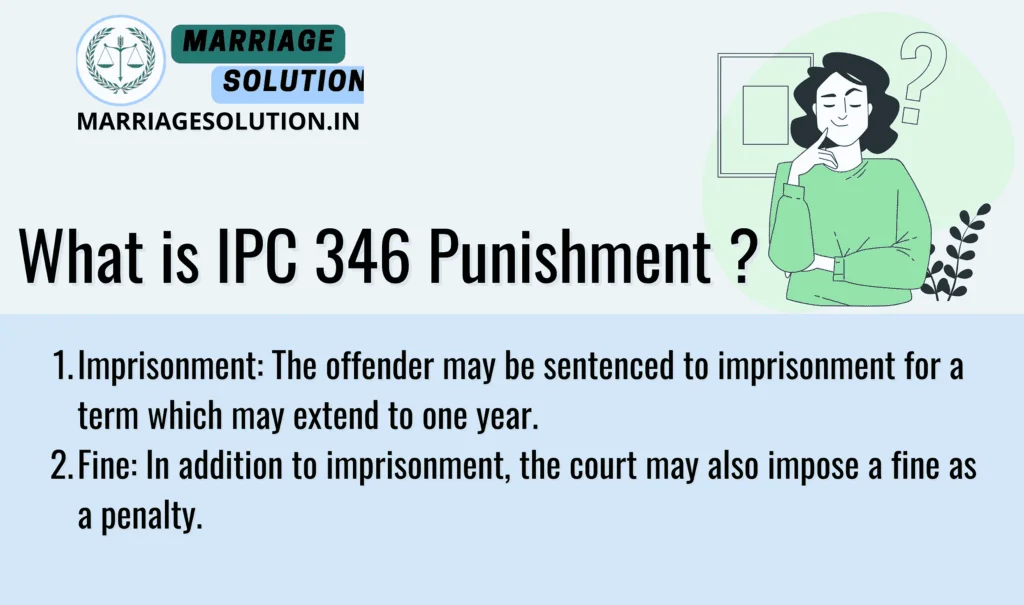
Punishment: The punishment for Section 346 of IPC isn’t specified in the law itself.
- Imprisonment: The offender may be sentenced to imprisonment for a term which may extend to one year.
- Fine: In addition to imprisonment, the court may also impose a fine as a penalty.
Legal Representation: Defendants have the right to get help from a lawyer to make sure they’re treated fairly in court.
Section 346 IPC in shot information:
| What is Mean | Description |
|---|---|
| Offense | Secretly confining someone without permission. |
| Punishment | The punishment isn’t specified in the section; it’s decided by the court based on the case. |
| Bailable | Accused individuals can usually ask for bail, but it depends on the court’s decision and the case. |
IPC 346 FAQS
Q: What is IPC Section 346 about?
A: IPC Section 346 is about secretly holding someone against their will.
Q: What happens if someone secretly holds another person?
A: It’s against the law. The person doing it can get in trouble.
Q: What punishment do people get for secretly holding someone?
A: The court decides the punishment based on how serious the situation is.
Q: What does the court consider when deciding if someone can get out of jail?
A: The court looks at things like how serious the offense is and if the person might run away.
If you need support with court proceedings or any other legal matters, don’t hesitate to reach out for assistance.
Court or any other marriage-related issues, our https://marriagesolution.in/lawyer-help-1/ website may prove helpful. By completing our enquiry form and submitting it online, we can provide customized guidance to navigate through the process effectively. Don’t hesitate to contact us for personalized solutions; we are here to assist you whenever necessary!
- Court Marriage in India: Complete Process, Timeline & Inter-Caste Incentives
 More couples in India are choosing court marriage over traditional ceremonies every year — whether for simplicity, personal choice, or the legal recognition it provides without the scale of a full wedding. A court marriage is like a legal love story, where two hearts sign a lifelong contract of love and companionship. That framing captures… Read more: Court Marriage in India: Complete Process, Timeline & Inter-Caste Incentives
 - AFSPA Act
 AFSPA act mean Armed Forces Special Powers Act (AFSPA) grants special powers to the Indian Armed Forces in areas classified as “disturbed” due to significant insurgency or internal disturbances.
 - Right to Information RTI act :Your Comprehensive Guide (Part 1)
 The Right to Information (RTI) Act : Explore the essence of the Right to Information (RTI) Act through this symbolic image. The image features legal documents, emphasizing the importance of transparency and accountability in governance. The scales of justice represent the balance achieved through the citizens’ right to access information.
 - What is Article 371 of Indian Constitution ?Article 371 of the Indian Constitution grants special provisions to specific states and regions within India, addressing their unique historical, social, and cultural circumstances. These provisions aim to accommodate diverse needs and protect cultural identities within the constitutional framework.
- Indian Labour law : Your Comprehensive Guide (Part 1)
 The purpose of labour laws is to safeguard employees and guarantee equitable treatment at the workplace, encompassing aspects such as remuneration, security, and perks. These regulations establish a secure ambiance by imposing minimum wage requirements, ensuring factory safety measures are implemented effectively while granting rights like maternal leave entitlements. Abiding by these principles promulgates an impartial work culture encapsulating upright conduct; thereby cultivating conducive surroundings for progressive development.
Official website of the Maharashtra government’s police department for help and support.
https://www.mahapolice.gov.in/ https://www.mahapolice.gov.in/ visit the official website of the Maharashtra government for any requirements or inquiries.