Introduction of 214 BNS
214 BNS deals with situations where a person is legally required to answer questions posed by a public servant but refuses to do so. When a public servant, such as a police officer or magistrate, is authorized by law to ask questions, and the person refuses to provide answers, this refusal becomes an offence under BNS Section 2214.
The Bharatiya Nyaya Sanhita (BNS) Section 214 replaces the old Indian Penal Code (IPC) Section 179.
What is BNS Section 214 ?
BNS Section 214 makes it an offence for a person to refuse to answer questions that they are legally bound to answer, when asked by a public servant authorized to question them. The refusal can lead to punishment with simple imprisonment for up to six months or a fine of up to ₹5,000, or both. The law ensures that people cooperate with public officials when they are carrying out their legal duties.

Under Section 214 of the bns act 2023
“Whoever, being legally bound to answer a question put to him by a public servant authorized by law to ask such question, refuses to answer, shall be punished with simple imprisonment for a term which may extend to six months, or with fine which may extend to five thousand rupees, or with both.”
1. Meaning of “Refusing to Answer Public Servant”
- A public servant (like a police officer, magistrate, or judge) has the legal authority to ask certain questions during investigations, inquiries, or legal proceedings.
- If a person is legally bound to answer and still refuses to respond, it is treated as an offence under this section.
- The refusal is not about lying or giving false information (that is covered under Section 212); it specifically refers to not answering at all when required.
2. Who is Covered?
This section applies to:
- Individuals questioned by police officers during an authorized investigation.
- Witnesses or parties in court when a magistrate or judge asks questions.
- Any person legally bound under law or order to respond to public servant’s questioning.
Example: A person summoned to give information about an accident, but who refuses to answer the magistrate’s questions, is covered.
3. Nature of the Offence
- Non-cognizable → Police cannot arrest without a warrant.
- Bailable → The accused can seek bail as a matter of right.
- Non-compoundable → The case cannot be privately settled; it must proceed in court.
- Triable by any Magistrate → Any Magistrate can hear the case.
4. Examples of BNS Section 214
- Example 1 – Refusal before Police:
During a theft investigation, a police officer asks Ravi if he saw the suspect near the crime scene. Ravi was present but refuses to answer any questions. He is guilty under BNS 214. - Example 2 – Refusal before Magistrate:
A magistrate questions a witness about a property dispute. The witness deliberately refuses to answer, despite being legally required. This refusal makes the witness liable under Section 214. - Example 3 – Not Guilty Situation:
If a person remains silent because the question would incriminate them, and the law provides them protection against self-incrimination (Article 20(3) of the Constitution), then refusal is not punishable.
5. Punishment under BNS Section 214
- Imprisonment → Up to 6 months simple imprisonment.
- Fine → Up to ₹5,000.
- Both → The court may impose both depending on the seriousness.
6. Importance of BNS Section 214
- Ensures Cooperation → Prevents people from avoiding lawful questioning.
- Supports Justice → Helps public servants gather accurate information.
- Prevents Obstruction → Discourages deliberate refusal that delays investigations.
- Balances Rights → Makes refusal punishable but keeps offence non-cognizable and bailable to prevent misuse.
Section 214 BNS Overview
BNS Section 214 punishes a person who is legally bound to answer questions posed by a public servant but refuses to do so. If the public servant is acting within their legal authority and the individual refuses to answer questions truthfully or at all, it is an offence under this section. The person may face imprisonment for up to six months, a fine of up to ₹5,000, or both.
BNS Section 214: 10 Key Points Explained in Simple English
- Legal Obligation to Answer Public Servants: Under BNS Section 214, if a person is legally required to answer questions asked by a public servant (like a police officer or magistrate), they must provide truthful answers. Refusing to answer these questions is considered an offence under this law.
- Public Servants with Legal Authority: The public servant must be legally authorized to ask these questions. This could happen during an investigation, inquiry, or any official duty that requires the person to provide information. The law gives these officials the right to ask questions for legal purposes.
- Refusal to Answer: If the person refuses to answer the questions when legally required, it is treated as a violation of the law. Refusing to respond can be seen as obstructing justice or hindering the public servant’s duty.
- Imprisonment as Punishment: The law allows for punishment if a person refuses to answer a public servant’s questions. They can be sentenced to simple imprisonment for a period of up to six months. This imprisonment is meant to enforce compliance and ensure people cooperate with public officials.
- Fine as an Alternative Punishment: Instead of imprisonment, or sometimes along with it, the offender can be fined up to ₹5,000. This fine is a monetary penalty for refusing to answer the questions of a public servant.
- Combination of Imprisonment and Fine: The law allows for both imprisonment and a fine. This means that, in some cases, a person who refuses to answer may face both jail time and a financial penalty depending on the seriousness of the refusal.
- Non-Cognizable Offence: BNS Section 214 is classified as a non-cognizable offence, which means that the police cannot arrest the person without a warrant. A court’s permission is required for any arrest to take place in such cases.
- Bailable Offence: Since this is a bailable offence, a person charged under this section can apply for bail. This means that they do not have to stay in jail while they wait for their trial, as long as they meet the bail conditions set by the court.
- Tried by Any Magistrate: Cases related to BNS Section 214 can be tried by any Magistrate. This makes the trial process simpler, as it does not require a higher court, and the trial can take place at the local level.
- Prevents Obstruction of Justice: The main purpose of BNS Section 214 is to ensure that people do not refuse to provide necessary information to public servants. This section is important to prevent any obstruction in the investigation process or legal proceedings, ensuring that justice is served efficiently.
Examples of BNS Section 214:
- Example 1: A police officer, during a criminal investigation, asks Mr. B if he witnessed an accident. Mr. B was present at the scene and is legally required to give truthful information. However, Mr. B refuses to answer any of the police officer’s questions. Here, Mr. B is committing an offence under BNS Section 214 for refusing to answer a legally authorized question.
- Example 2: During a court inquiry, the magistrate asks Ms. C whether she has seen a suspect in a theft case. Ms. C, being legally obligated to state the truth and answer questions, refuses to provide any information or respond. Her refusal to answer the magistrate’s question constitutes an offence under BNS Section 214, and she may be punished for her refusal.
BNS 214 Punishment
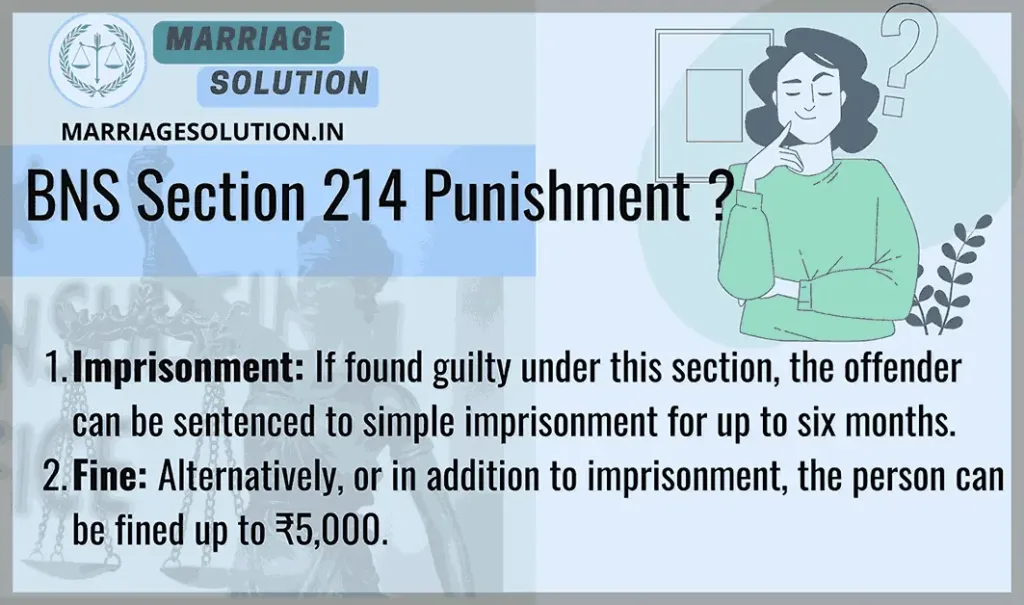
- Imprisonment: If found guilty under this section, the offender can be sentenced to simple imprisonment for up to six months.
- Fine: Alternatively, or in addition to imprisonment, the person can be fined up to ₹5,000.
BNS 214 bailable or not ?
BNS Section 214 is a bailable offence. This means that if a person is charged under this section, they have the right to apply for bail and be released from custody while waiting for their trial.
Comparison Table – BNS Section 214 vs IPC Section 179
| Section | What it Means | Punishment | Bail | Cognizable? | Trial By |
|---|---|---|---|---|---|
| BNS Section 214 | Deals with refusal to answer questions or giving false information when a person is legally bound to reply to a public servant. Ensures truthfulness in official proceedings. | Simple imprisonment up to 6 months, or fine up to ₹5,000, or both. | Bailable | Non-Cognizable | Any Magistrate |
| IPC Section 179 (Old) | Punished refusal to answer or giving false information to a public servant authorized to question, but imposed a smaller fine and used outdated wording. | Simple imprisonment up to 6 months, or fine up to ₹1,000, or both. | Bailable | Non-Cognizable | Any Magistrate |
| Key Difference: BNS 214 modernizes IPC 179 by increasing the fine from ₹1,000 to ₹5,000 and simplifying the language. The goal remains the same — to ensure cooperation with lawful questioning by public servants. | |||||
BNS Section 214 FAQs
What is the main offence under BNS Section 214?
The main offence is refusing to answer questions from a public servant, such as a police officer or magistrate, when legally required to do so.
What is the punishment under Section 214?
The punishment can be simple imprisonment for up to six months, a fine of up to ₹5,000, or both.
Is Section 214 a bailable offence?
Yes, it is a bailable offence, meaning the accused can apply for bail.
Can the police arrest without a warrant for this offence?
No, it is a non-cognizable offence, so the police cannot arrest someone without a warrant.
Who can try cases under Section 214?
Any Magistrate can try cases under Section 214, or the court where the offence was committed.
Does refusal to answer always result in imprisonment?
No, the court can impose either imprisonment, a fine, or both, depending on the situation.
Conclusion
BNS Section 214 ensures that individuals cannot evade legal responsibility by refusing to answer questions from public servants. Courts, police, and other authorities depend on cooperation to uncover the truth, and refusal to answer hinders justice.
By prescribing up to six months of simple imprisonment or a fine of ₹5,000 (or both), the law sets clear consequences for non-cooperation. This provision strikes a balance by making the offence bailable and non-cognizable, but still serious enough to enforce compliance. In short, Section 214 strengthens accountability and helps protect the integrity of investigations and legal processes.
Need Legal Support?
If you are dealing with court cases, marriage problems, or any other legal issue, our team at Marriage Solution – Lawyer Help is here for you. Simply fill out our quick online enquiry form, and we’ll connect you with the right legal expert to support your needs.
Finished with BNS 214? Continue exploring the next provisions of the Bharatiya Nyaya Sanhita (BNS), 2023. Each section includes explanations, examples, and plain-language breakdowns for easy understanding.
- BNS 215 : Refusing to sign statement.
- https://marriagesolution.in/bns_section/bns-215/
- 216 BNS : False statement on oath or affirmation to public servant or person authorised to administer an oath or affirmation.
- https://marriagesolution.in/bns_section/216-bns/
- BNS 217 : Giving false information on purpose to a public servant so that they use their legal powers in a way that harms someone else.
- https://marriagesolution.in/bns_section/bns-217/
- BNS 218 : Resistance to the taking of property by the lawful authority of a public servant.
- https://marriagesolution.in/bns_section/bns-218/
- BNS 219 : Obstructing sale of property offered for sale by authority of public servant.
- https://marriagesolution.in/bns_section/bns-219/
Full IPC Section List: https://marriagesolution.in/ipc-section-list
All Indian Law & Blogs: https://marriagesolution.in/indian-law/
Full BNSS Section List: https://marriagesolution.in/bnss_section-list