
Introduction of Section 59 BNS
Section 59 BNS deals with public servants who intentionally hide plans to commit a crime that they are supposed to prevent. If a public servant, like a police officer, knows about such a plan and hides it or lies about it, they can be punished under this section.
The Bharatiya Nyaya Sanhita (BNS) Section 59 replaces the old Indian Penal Code (IPC) Section 119.
What is section 59 of BNS ?
BNS Section 59 is a legal provision that ensures public servants fulfill their duty to prevent crimes. It punishes those who intentionally hide or lie about crime plans that they are responsible for stopping. The punishment depends on whether the crime actually happens and how serious the crime is, with possible jail time and fines as consequences.
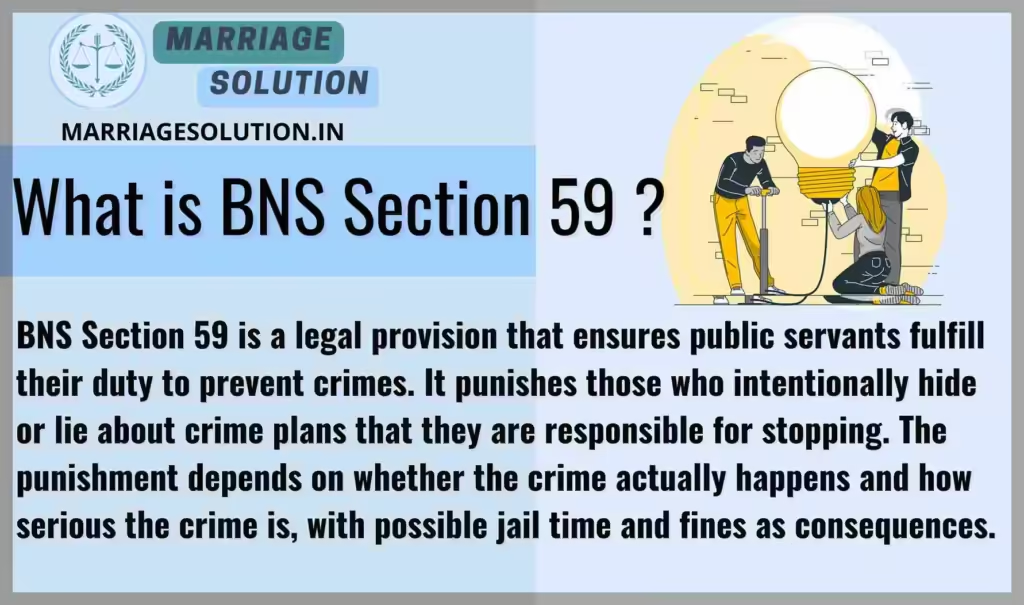
Section 59 of Bharatiya Nyaya Sanhita
BNS Section 59 says that if a public servant (like a police officer, magistrate, or other government authority) knows about a crime being planned, but instead of reporting or stopping it, hides it or lies about it, then that public servant is guilty of an offence.
This is serious because public servants have a duty to protect society. If they hide such plans, they fail in their official responsibility, and the law treats it as a crime.
This section replaces IPC Section 119 from the old Indian Penal Code.
1. What does this section mean?
This law applies only to public servants. Their job is to maintain law and order and prevent crimes. If they know about a crime plan but decide to stay silent, mislead others, or hide the information, they are guilty under Section 59.
For example:
- If a police officer knows about a murder plan but keeps quiet, he is guilty.
- If a magistrate lies about details of a robbery plan to protect criminals, he is guilty.
- Even if they use technology to delete or hide digital evidence, it is still concealment.
2. Why is this section important?
Ordinary people may or may not report crimes, but public servants have a legal duty to prevent them. Society trusts them with authority, and if they fail, crimes become easier to commit.
By punishing concealment by public servants, the law ensures that those who are in charge of protecting people cannot misuse their position.
3. Punishment under BNS Section 59
The punishment depends on the situation:
- If the crime happens → The public servant can be jailed for up to half of the maximum punishment for that crime, or fined, or both.
- If the crime does not happen → The public servant can be jailed for up to one-fourth of the maximum punishment for that crime, or fined, or both.
- If the crime is very serious (death or life imprisonment) → The public servant can face up to 10 years of imprisonment.
This shows the law takes concealment by public servants very seriously.
4. Nature of the offence
- Bailable or Non-Bailable → Depends on the crime being hidden.
- If it is a very serious crime (death or life imprisonment), it is non-bailable.
- If it is a less serious crime, it may be bailable.
- Cognizable → Police can investigate.
- Trial by → The case will be tried by the same court that handles the main crime.
5. Examples to understand this section better
Example 1: A police officer knows a gang is planning a robbery. He hides the information. The robbery takes place. He can be punished with up to half of the maximum punishment for robbery.
Example 2: A jail officer learns about a plan of prisoners to escape. He deletes the messages and does not report. Even if the escape does not happen, he can still be jailed up to one-fourth of the maximum punishment for prison escape.
Example 3: A public servant learns of a terrorist plot but lies to his superiors. Since this is a crime punishable with death or life imprisonment, he can face up to 10 years in prison.
6. Importance of this Section
This section is important because it makes public servants accountable. It ensures they cannot misuse their power by protecting criminals or ignoring their duty.
It also protects society, because crimes can be stopped at the planning stage if public servants report them honestly.
The law makes it clear: public servants are not above the law. If they hide crime plans, they are treated as criminals themselves.
Section 59 BNS Overview
BNSS Section 59 makes it a punishable offence if a public servant (like a police officer, magistrate, or government official) knowingly hides, lies about, or misrepresents information regarding a planned crime. Since public servants have a duty to protect society, failing to report or deliberately hiding a crime plan makes them legally responsible.
This section applies whether the crime is serious (like murder, terrorism, robbery) or minor, and punishment depends on the seriousness of the offense being hidden.
10 Key Points of BNSS Section 59
1. Duty of Public Servants
Public servants are trusted with the responsibility to protect law and order. If they know about a crime being planned, they must act to stop it. Failure to do so violates their official duty and becomes a crime under this section.
2. Hiding Crime Plans
If a public servant intentionally hides knowledge of a crime plan, they are breaking the law. This covers situations where they choose silence or inaction instead of reporting the crime.
3. Lying About the Crime
If a public servant gives false information about a planned crime or misleads others, they can be punished. For example, if they know the details of a gang planning robbery but deliberately give wrong facts, it counts as an offence.
4. Use of Technology
Even if the concealment is done through modern tools—like encryption, deleting digital evidence, or using technology to hide crime details—the public servant is still responsible. Technology cannot be an excuse.
5. Punishment If Crime Occurs
If the planned crime actually happens, the public servant can be punished with imprisonment up to half of the maximum punishment for that crime. This shows how seriously the law views their negligence or dishonesty.
6. Punishment If Crime Doesn’t Occur
If the crime does not actually take place, the public servant still faces punishment—up to one-fourth of the maximum punishment for the crime that was being planned. This ensures accountability even if the plan fails.
7. Severe Punishment for Serious Crimes
If the hidden crime is of a grave nature—punishable with death or life imprisonment—the punishment for the public servant can extend up to 10 years of imprisonment. This covers crimes like terrorism, murder, or large-scale organized crime.
8. Fines
Apart from imprisonment, the public servant can also be fined. The fine amount depends on the seriousness of the crime that was concealed.
9. Bailable or Non-Bailable
The classification of the offence depends on the seriousness of the crime hidden. If it relates to serious crimes (murder, terrorism, etc.), the offence is non-bailable. For less severe crimes, it may be bailable.
10. Legal Accountability
This section makes it clear that public servants are not above the law. They are legally accountable for their actions and omissions. Ignoring, hiding, or lying about crime information is treated as a crime in itself.
Example Explained
Imagine a police officer named A knows that a gang is planning a robbery in the city. Instead of reporting it or taking steps to stop it, A chooses to hide the information. If the robbery actually takes place, A can be punished with up to half the maximum punishment of robbery. Even if the robbery does not happen, A can still be punished with up to one-fourth of the punishment for robbery.
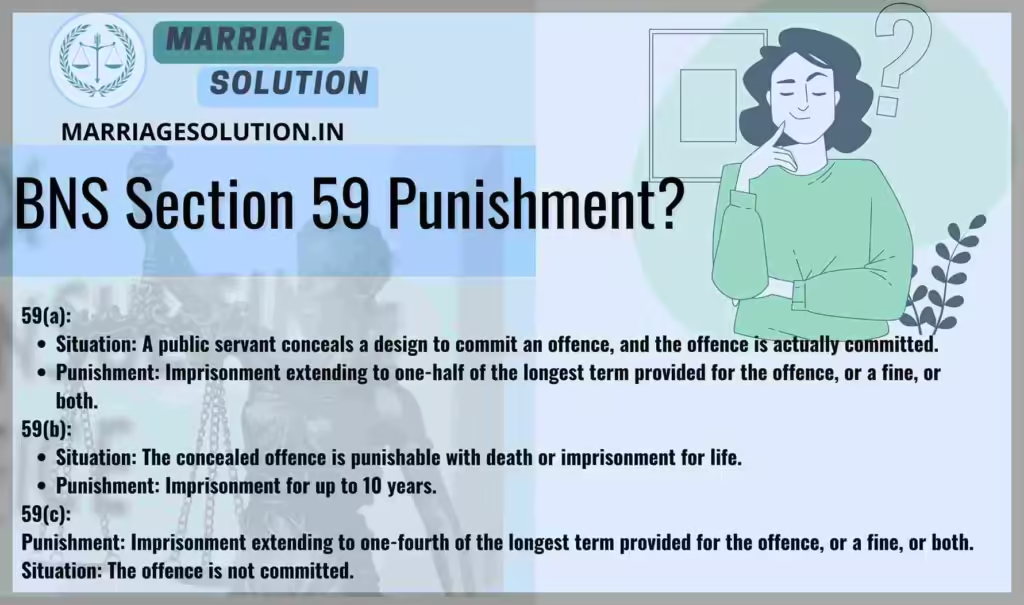
BNS 59 Punishment
59(a):
- Situation: A public servant conceals a design to commit an offence, and the offence is actually committed.
- Punishment: Imprisonment extending to one-half of the longest term provided for the offence, or a fine, or both.
59(b):
- Situation: The concealed offence is punishable with death or imprisonment for life.
- Punishment: Imprisonment for up to 10 years.
59(c):
Punishment: Imprisonment extending to one-fourth of the longest term provided for the offence, or a fine, or both.
Situation: The offence is not committed.
BNS 59 bailable or not ?
Non-Bailable: If the crime involved is severe, such as one punishable by death or life imprisonment.
Bailable: If the crime is less severe or if the crime does not actually happen.
Bharatiya Nyaya Sanhita Section 59
| Clause | Situation | Imprisonment / Fine | Bailable or Not | Triable by Which Court |
|---|---|---|---|---|
| 59(a) | If the offence is actually committed after the public servant hides the plan. | Jail up to one-half of the longest term given for that offence, or fine, or both. | Depends on the type of offence abetted. | The same court which tries the offence that was abetted. |
| 59(b) | If the offence is one that is punishable with death or life imprisonment. | Jail up to 10 years. | Non-bailable. | The same court which tries the offence that was abetted. |
| 59(c) | If the offence is not committed after the concealment by the public servant. | Jail up to one-fourth of the longest term for that offence, or fine, or both. | Depends on the type of offence abetted. | The same court which tries the offence that was abetted. |
Comparison: BNS Section 59 vs IPC Section 119
| Section | Offence | Punishment | Bailable / Non-Bailable | Cognizable / Non-Cognizable | Trial By |
|---|---|---|---|---|---|
| BNS Section 59 |
Public servant hides or lies about a crime plan which they were supposed to stop. Covers both old ways and modern ways (like using technology). |
• If crime happens → Jail up to half of maximum punishment for that crime, or fine, or both. • If crime does not happen → Jail up to one-fourth of maximum punishment, or fine, or both. • If crime is very serious (death or life imprisonment) → Jail up to 10 years. |
Non-bailable if crime is very serious (death or life term). Otherwise bailable depending on the crime. |
Cognizable | Court that handles the hidden crime |
| IPC Section 119 (Old) |
Public servant hides a crime plan which they were supposed to stop. Only focused on old methods, no mention of modern ways. |
• If crime happens → Jail up to half of maximum punishment for that crime, or fine, or both. • If crime does not happen → Jail up to one-fourth of maximum punishment, or fine, or both. • If crime is very serious (death or life imprisonment) → Jail up to 10 years. |
Non-bailable if crime is very serious (death or life term). Otherwise bailable depending on the crime. |
Cognizable | Court that handles the hidden crime |
BNS Section 59 FAQs
What is BNS Section 59 about?
BNS Section 59 addresses the situation where a public servant intentionally conceals a design to commit an offence that it is their duty to prevent. The section outlines the punishments if the offence is committed, if it is punishable by death or life imprisonment, or if the offence is not committed.
What is the punishment under BNS Section 59(a) if the offence is committed?
If the offence is committed, the public servant may face imprisonment extending to one-half of the longest term provided for the offence, or a fine, or both.
What happens if the concealed offence under BNS Section 59(b) is punishable by death or life imprisonment?
In this case, the public servant may be punished with imprisonment for up to 10 years.
What is the punishment under BNS Section 59(c) if the offence is not committed?
If the offence is not committed, the public servant may face imprisonment extending to one-fourth of the longest term provided for the offence, or a fine, or both.
Is BNS Section 59 bailable or non-bailable?
The bailability depends on the nature of the offence abetted. For example, if the concealed offence is punishable with death or life imprisonment (as in 59(b)), it is non-bailable. For other offences, it may vary based on the specific nature of the offence.
Conclusion
Section 59 of the Bharatiya Nyaya Sanhita plays an important role in making public servants accountable for their duty. It clearly says that if a public servant knowingly hides or lies about a crime plan, they can be punished. This law ensures that those who are trusted to protect society cannot misuse their power or stay silent when they should act.
The punishment depends on the seriousness of the crime, but the main idea is clear—public servants are not above the law. By enforcing this section, society gets extra protection because crimes can be stopped at the planning stage itself. Section 59 builds trust between the public and the authorities by ensuring that honesty and responsibility remain at the core of public service.
Need Legal Support?
If you are dealing with court cases, marriage problems, or any other legal issue, our team at Marriage Solution – Lawyer Help is here for you. Simply fill out our quick online enquiry form, and we’ll connect you with the right legal expert to support your needs.
Finished with BNS 59 ? Continue exploring the next provisions of the Bharatiya Nyaya Sanhita (BNS), 2023. Each section includes explanations, examples, and plain-language breakdowns for easy understanding.
- BNS 60 : Concealing design to commit offence punishable with imprisonment https://marriagesolution.in/bns_section/section-60-bns/
- BNS 61 : Criminal conspiracy.
- https://marriagesolution.in/bns_section/bns-section-61/
- BNS 62 : Punishment for attempting to commit offences punishable with imprisonment for life or other imprisonment.
- https://marriagesolution.in/bns_section/bns-section-62/
- BNS Section 63 : Rape .
- https://marriagesolution.in/bns_section/bns-section-63/
- BNS Section 64 : Punishment for rape .
- https://marriagesolution.in/bns_section/bns-section-64/
Full IPC Section List: https://marriagesolution.in/ipc-section-list
All Indian Law & Blogs: https://marriagesolution.in/indian-law/
Full BNSS Section List: https://marriagesolution.in/bnss_section-list